Coco Chanel built a legacy by doing the opposite of what fashion expected. She took fabrics meant for men's underwear and made them chic. She shortened skirts, simplified silhouettes, and told women to dress for themselves. Nearly every one of those rebellions now reads as common sense.
That is the strange arithmetic of the coco chanel legacy: the ideas that once scandalized Paris stopped being ideas at all. They became the wardrobe. A black dress you can wear from day to night, a jacket you can move in, a perfume you buy without thinking — each one started as a refusal.
This guide walks through the rules she broke, why each break mattered, and what her method still teaches anyone who gets dressed, designs clothes, or watches the industry from the front row.
Who Was Coco Chanel, and Why Does She Still Matter?
Gabrielle Chanel came to fashion from the outside. She began as a milliner and a singer in café-concert rooms, without formal atelier training, and she never quite forgave the establishment for it. That outsider position shaped her taste: she distrusted ornament, disliked anything that restricted the body, and treated comfort as a style principle rather than a concession.
Her influence outlasted her lifetime because she changed the structure of women's clothing, not just its decoration. Before her, fashionable dress was largely about shaping the body to a silhouette. After her, it was increasingly about freeing the body and letting the clothes serve the wearer. That shift is why her name still anchors conversations about the The Most Influential Fashion Designers of All Time, Ranked, and why every new creative director at the house she founded is measured against her instincts.
The read, from this desk: Chanel's real innovation was not a single garment. It was the argument that a woman's wardrobe should be practical, and that practicality could be luxurious. Fashion has been litigating and extending that argument ever since.
What Rules Did She Actually Break?
Several, and each one stuck. The clearest examples:
- Fabric hierarchy. She used jersey, a cheap knit associated with men's undergarments and workwear, for elegant daywear. The message was radical: a fabric's social class did not determine its chic.
- The corset. She loosened and then abandoned the structured underpinnings that defined the Edwardian silhouette. Her clothes hung from the shoulders and waist rather than compressing the torso into an hourglass.
- Hemlines and proportions. She shortened skirts and simplified lines well before that was respectable, arguing that women needed to walk, work, and move.
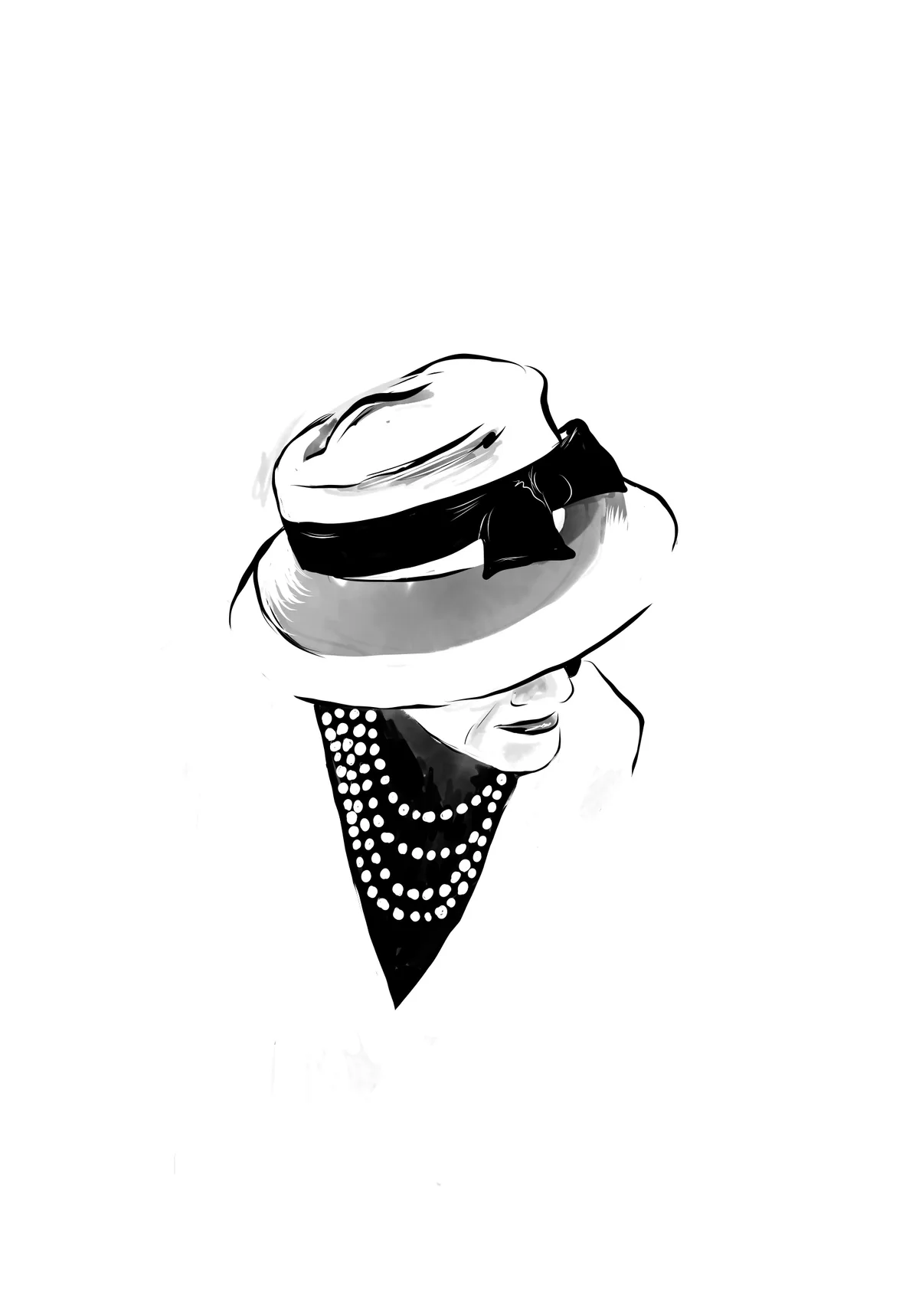
- Borrowing from menswear. She lifted tailoring details, cuts, and even the idea of a boater hat from men's wardrobes and made them feminine on her own terms.
- Color discipline. Her black, beige, gold, and red palette treated restraint as sophistication, at a time when lavish color and trim signaled wealth.
Notice the pattern. None of these breaks were about shock for its own sake. They were arguments about how women actually lived, and the market eventually agreed with her. Compare that with designers who broke rules as theater — Rei Kawakubo's deliberate ugliness, or Vivienne Westwood's punk provocation, both covered in our profiles of Rei Kawakubo Built Comme des Garçons by Refusing to Play by the Rules and Vivienne Westwood: How Punk Became Haute Couture. Chanel's rebellions succeeded because they made daily life easier, not because they made headlines.
Why Did the Little Black Dress Become So Important?
The little black dress is the clearest case of a rebellion becoming a default. In an era when black was largely reserved for mourning and servants, Chanel proposed it as the most versatile, most elegant garment a woman could own. The idea was not that black was dramatic. It was that black was useful — a dress that could travel, work, dine, and mourn without a costume change.
Vogue's famous framing of the concept as a kind of uniform for women is part of fashion's standard history, and the garment's endurance proves the point better than any quote. A century of designers, from Hubert de Givenchy's work for Audrey Hepburn to the minimalism of the 1990s, kept returning to the same template. When a rebellion becomes a cliché, that is usually the sign it won.
What this means for your wardrobe: the little black dress endures not because it is fashionable but because it solves a problem. Any garment that solves a problem — the right cut, the right weight, the right simplicity — will outlast the season that produced it. That is the transferable lesson of her method.
How Did She Change the Way Women Move?
The Chanel suit is the other pillar. Its genius is easy to miss because it looks so orderly: a collarless jacket, a skirt, braid trim, buttons of polished metal or jewel. But the construction was a quiet insurrection. The jacket was cut with ease through the body, weighted at the hem with a chain so it hung cleanly, and lined with a supple layer that let the wearer reach, drive, and gesture without strain.
She took the language of men's tailoring — the comfort, the function — and rebuilt it for women without making it a costume of masculinity. That distinction matters. Borrowing menswear is common now; making it feel inherently feminine, on the wearer's terms, was her particular skill. Later designers argued with her formula in different registers: Azzedine Alaïa sculpted the body directly, as we covered in Azzedine Alaïa: The Perfectionist Who Refused the Calendar, while Tom Ford weaponized desire at Gucci, per our piece Tom Ford: The Decade He Made Gucci the Sexiest Word in Fashion. Each of them was working in the space her loosening of the silhouette opened.
One craft detail worth knowing: the chain sewn into the jacket's hem. It is the kind of solution that looks like decoration and is actually engineering — proof that her comfort argument was built, not just talked.
What Can Today's Designers Still Learn From Her Method?
Three lessons survive intact, and they apply well beyond one house.
- Design for the life, not the occasion. Chanel's clothes assumed women had places to go and things to do. That assumption, obvious now, was the break. Any collection that starts from how a customer actually lives is speaking her language.
- Restriction is a design failure. When a garment fights the body, the body usually wins. Her career is the standing argument that ease and elegance are not opposites.
- Simplicity is harder than ornament. A plain dress with a perfect cut requires more skill than a busy one with trim to hide behind. The discipline of removal — deciding what to leave out — is the method underneath the mythology.
There is also a business lesson. She understood early that a name, a fragrance, and a signature accessory could carry a house beyond the runway. That model — the idea as brand — is what Miuccia Prada later proved at scale, as we argued in Miuccia Prada Proved That Ideas Can Sell Handbags.
Where Does Her Legacy Sit Now?
Her name has traveled far beyond fashion. The given name Coco now carries its own cultural weight — most visibly in Pixar's 2017 animated film Coco, which follows a boy named Miguel through the Land of the Dead; per Wikipedia's overview of Coco, the film earned critical acclaim and grossed over $823 million worldwide. A designer's first name becoming a household word independent of the house is a rare form of legacy.
Within fashion, her influence is less a look than a permission structure. Every designer who dresses a woman for motion, every capsule built on a disciplined palette, every jacket engineered to feel as good as it photographs is working downstream of her. The rebellions stuck because they were correct. That, in the end, is the whole of the coco chanel legacy: she broke rules that deserved breaking, and the wardrobe we all live in is the settlement.
What to watch next: each new collection at the house she founded is a fresh negotiation with her instincts — and the moments when a creative director breaks one of her rules in turn are the ones worth watching.