Rei Kawakubo built one of fashion’s most independent houses without a single day of design school. A literature graduate of Keio University, she moved from styling assignments at a Tokyo textile company in 1967 to founding Comme des Garçons in 1969 — and for more than five decades the house has operated on her terms alone: no outside investors, no licensed fragrances sold as the main business, no explanations on the runway.
How did a stylist become a designer?
The pattern was set early. After graduating, Kawakubo joined the textile firm Asahi Kasei as an advertising stylist, and the free-cloth library she ran for the apparel division turned her into a freelance stylist with a client list across Tokyo. When nothing on the market matched the clothes she wanted to wear, she began making them.
The name came first as a provocation. Comme des Garçons — French for “like the boys” — was borrowed from a Françoise Hardy song and applied to a womenswear line cut for movement rather than display. The first boutique opened in Aoyama in 1975; the menswear line followed in 1978.
The full story of that first decade now belongs to the record of Designers as much as to Tokyo — and the next act made it international.
Why did the Paris debut cause a scandal?
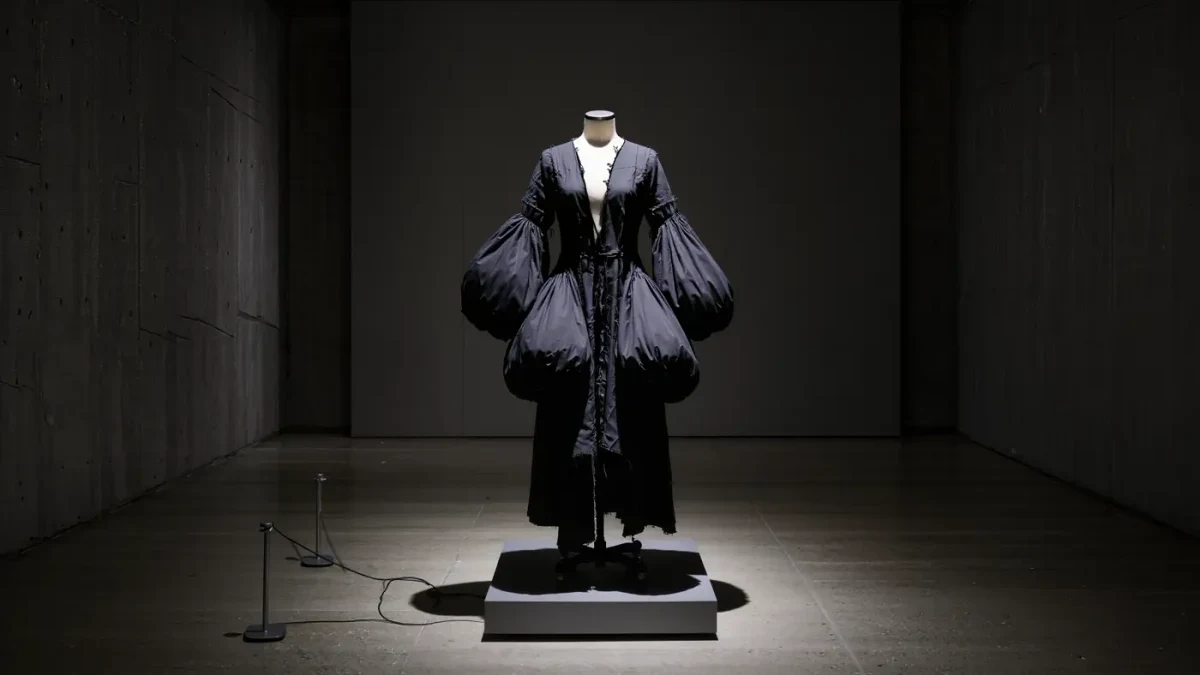
When Comme des Garçons showed in Paris in April 1981, the collection of stretched black knits, asymmetrical hems and deliberately raw edges was received as an affront. The French press called the look “Hiroshima chic,” a label Kawakubo rejected, and established buyers hedged their orders. Libertine boutiques in London and New York did not.
The read: what the room heard as destruction was a design argument — flatness instead of drape, asymmetry instead of fit, the gap between body and cloth as a design space. Within a few seasons that vocabulary had been absorbed by European fashion, and the students who founded Antwerp’s avant-garde credited the collection as their starting point.
What is the Comme des Garçons signature?
Refusal, executed precisely. Kawakubo designs against expectation: asymmetry against symmetry, black against color, the unwearable idea against the sellable product. The house’s shows rarely run past ten minutes; the campaigns rarely show a face; the collections are built around a single concept that she will not explain before the runway.
The system around the clothes is as much a signature. Dover Street Market, the retail concept she opened in London in 2004 with her husband Adrian Joffe, treats the store as a rotating exhibition — and now anchors the house in London, New York, Ginza and Los Angeles. The diffusion lines, including the heart-marked Play, fund the experiments without setting their agenda.
What does the house look like now?
Comme des Garçons remains privately held, with Kawakubo as owner and designer and Joffe running the commercial side. The runway calendar is her own — typically two womenswear collections a year in Paris, each presented without narration. The apprenticeship system inside the company has produced Junya Watanabe and Tao Kurihara, whose lines sit within the group without reporting to a committee.
The read: independence here is not a posture but an operating model. A house that answers to no group can show a collection of raw-edged tweed coats one season and a monochrome essay the next — and price neither as an apology.
What does the Comme des Garçons universe contain?
The group is larger than the runway suggests. More than a dozen diffusion and partner lines sit inside the company — Comme des Garçons Comme des Garçons, the archive-leaning Homme Plus, the wallet-driven Wallet line, Junya Watanabe’s own house, tao, and the long-running Play line whose heart logo, drawn by the Polish artist Filip Pagowski in 2002, became a retail phenomenon of its own. Each line is funded from the group, not from outside investors, and each can be paused when the idea is exhausted.
The retail arm runs on the same logic. Dover Street Market opened in London in 2004, moved to Haymarket in 2016, and now operates in New York, Ginza, Beijing and Los Angeles — each store built as a series of artist-designed spaces, re-hung twice a year, with the brands chosen by Kawakubo herself. The stores sell the group’s lines alongside the houses she respects, and the merchandising changes without announcement.
Why does she refuse interviews?
Kawakubo gives almost none, and the policy is consistent with the design: the clothes carry the argument, and explanation would fix a meaning she prefers to leave open. In the rare statements she has made — the 2008 lecture at her retrospective, the notes published with collections — the language returns to the same ideas: design as dissent, comfort as a trap, the value of a garment that a customer cannot immediately place.
The read: in an industry that now narrates everything in real time, the most radical act available to a designer may be silence — and she has held it for fifty years.
Frequently asked questions
Did Rei Kawakubo study fashion design? No. She read the history of aesthetics at Keio University and entered fashion through styling — the house learned its craft by making, not by school.
What does Comme des Garçons mean? It is French for “like the boys,” borrowed from a Françoise Hardy song when the label was registered in 1969.
Is Comme des Garçons independent? Yes. The company remains founder-owned, with no outside group controlling design or distribution.