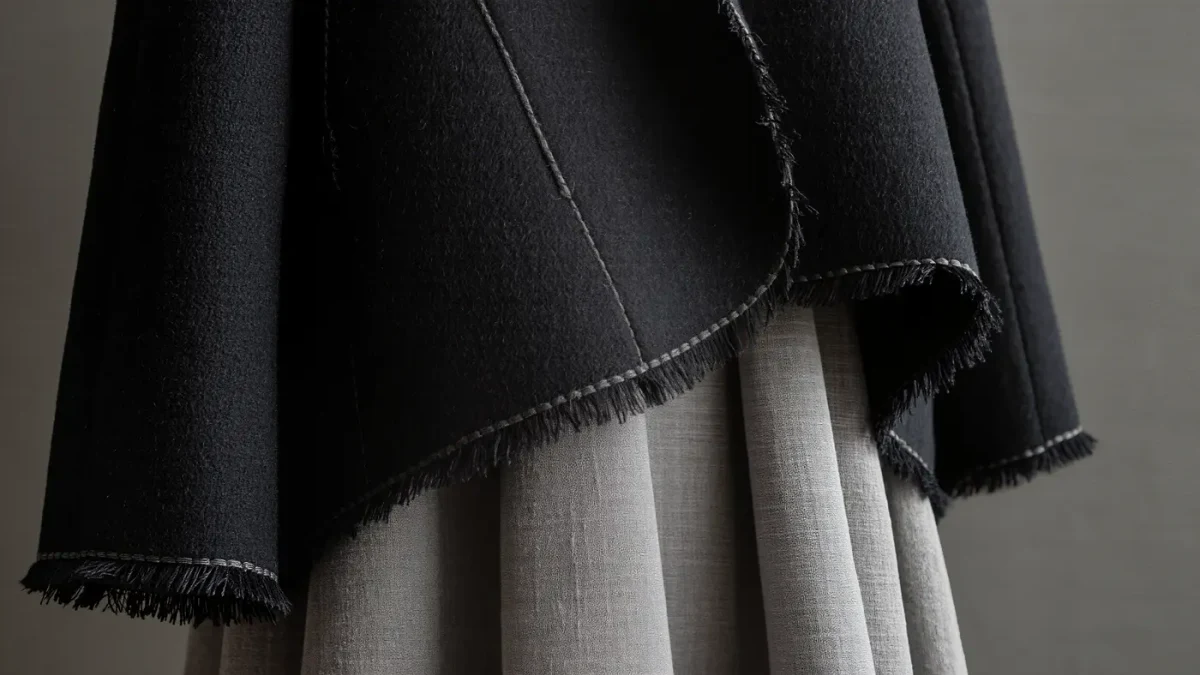
Paris, 1981. The clothes arriving from Tokyo that season hung away from the body in dark, unpressed volumes, cut with frayed, unfinished edges and holes. Yohji Yamamoto debuted in Paris that year, per Wikipedia's chronology of his career, and Rei Kawakubo began presenting her Comme des Garçons collections there each season. Journalists labeled the clothes "Hiroshima chic", per Wikipedia's account of Kawakubo's debut. The label was meant as a slight. It aged into a chapter heading.
The Japanese designers of that generation did not change hemlines. They changed what a silhouette was allowed to do. Where Paris trained the body into an hourglass, Tokyo proposed volume and asymmetry as beauty. The argument ran through three careers in particular, and each made the case differently.
Miyake: the cloth decides
Issey Miyake came to fashion through making. Born in Hiroshima in 1938, per Wikipedia's biography of Issey Miyake, he studied graphic design at Tama Art University before apprenticing under Guy Laroche in Paris. He went on to work with Hubert de Givenchy, drawing 50 to 100 sketches a day, per the same account. In 1970 he founded the Miyake Design Studio in Tokyo, and his north star was Madeleine Vionnet, with her idea of a single piece of beautiful cloth.
The pleats came later. In the late 1980s, per Wikipedia, Miyake began pressing finished garments between layers of paper in a heat press, and the fabric's memory holds the fold. The entry dates his patent to 1993, the same year he released the Pleats Please line. The idea grew out of dance; per the entry, he once sent 200 to 300 garments so a company could wear a different piece in each performance. In 1998 came A-POC, short for a piece of cloth, a tube of fabric the wearer cuts into shape, per the same entry. The throughline is consent between cloth and body. Nothing is forced.
Kawakubo and Yamamoto: the body, redrawn
Kawakubo founded Comme des Garçons in Tokyo in 1969, per Wikipedia, and built it on what the entry calls anti-fashion: austere, sometimes deconstructed garments. Her materials draped around the body with frayed, unfinished edges and holes. Yamamoto worked the same side of the street from a tailor's training. His first collection, under the label Y's, took typical men's garments as its pattern, per Wikipedia, cut in uncluttered shapes with washed fabrics and dark colors. He told The New York Times in 1983 that he wanted to make men's clothes for women. This connects to our earlier piece, Rei Kawakubo Built Comme des Garçons by Refusing to Play by the Rules.
Together they moved the center of gravity in Paris. Per Wikipedia, the Japanese press called Kawakubo and her followers the Crows, and the wardrobe matched the bird. Black absorbed the light and hid the seams; the volume did the talking. Proportion stopped being a code to follow and became a question each wearer could answer.
What the West borrowed
The read: the 1981 moment rewired the industry's defaults. Deconstruction moved from scandal to syllabus, and oversized black tailoring turned into a permanent language for cities that dress in a hurry. Kawakubo's reach now runs through retail itself; her store Dover Street Market trades on the same appetite for the unfinished. And the establishment made the point official in 2017, when the Metropolitan Museum of Art honored her, per Wikipedia, as the second living designer given an exhibition there, with the show opening that May. Its title, Art of the In-Between, framed the argument: her clothes live between dress and anti-dress, and the museum chose to stand in the gap.
Conclusion: the argument stays open
Tokyo keeps testing what a body can wear, and Paris keeps borrowing the answers. Watch the museum calendars for the next show that treats clothing as sculpture rather than costume, and watch the new generation of Tokyo designers for whoever inherits the volume. The question 1981 opened has never closed. How much space should a garment claim? The best answer so far is still the one that leaves room to move. For related coverage, see Christian Dior and the New Look: Why One Silhouette Still Rules Glamour.