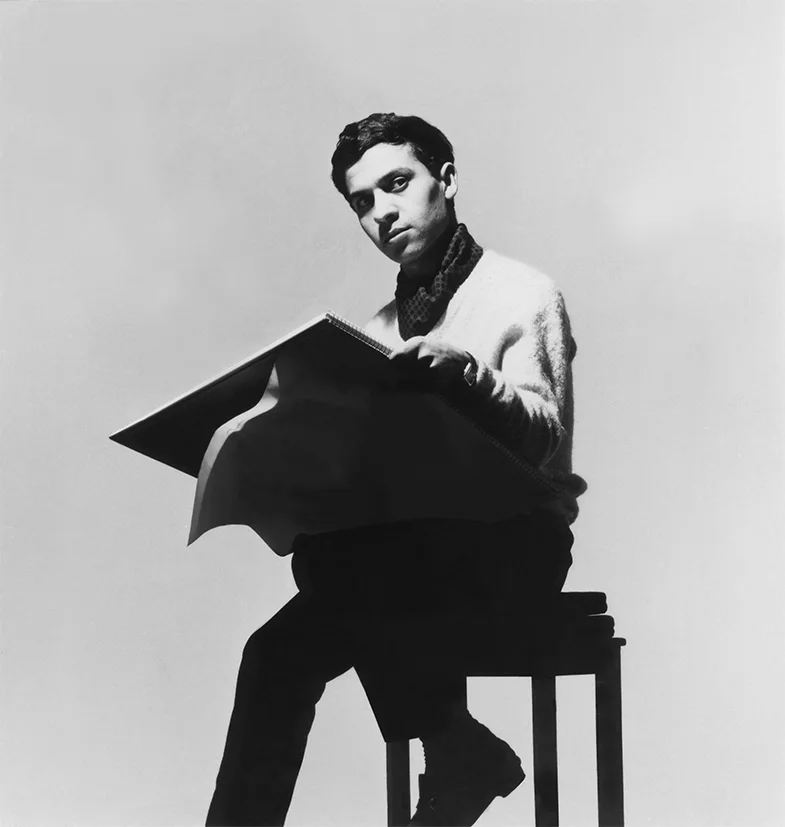
Christian Louboutin has told the story himself: sketching a Paris pump in 1992, he felt the design lacked energy, grabbed an assistant’s red nail polish and painted the sole. That flash — the red sole, registered and defended as a trademark — became one of the most recognizable signatures in Designers, identifiable from a single silhouette on a red carpet, and the subject of trademark law taught in business schools.
How did a shoemaker start in the Paris casinos?
Born in Paris in 1963 to a French mother and Egyptian father, Louboutin was expelled from school three times and left home at sixteen for the nightclubs of the city — the Follies Bergère and the Palace, where the showgirls’ heels fascinated him more than the shows. A notebook of sketches from those years survives: shoes drawn from the wings, never from the fittings.
The apprenticeship came at Charles Jourdan in 1976, then freelance work for Chanel, Yves Saint Laurent and Maud Frizon — the houses where he learned that a shoe is architecture before it is decoration. In 1991 he opened his first Paris boutique in a former passage, and Princess Caroline of Monaco was photographed buying a pair: the press did the rest.
What is the Louboutin signature?
The red sole, yes — but the craft underneath is the real story. His shoes are built on lasts refined over three decades, with arches engineered to flatter and heels balanced to be walked in. The ateliers in Paris still produce the couture-level commissions, and the factories in Italy execute the ready-to-wear with the same finishing.
The legal history is the modern chapter: the 2012 US Court of Appeals decision protecting the red outsole as trade dress made the sole a case study in intellectual property, and the house defends it in markets from Geneva to Jakarta.
What is the house doing now?
The brand has grown past shoes into beauty (the lip color in theSame collector’s casing), men’s footwear with its own boutiques, handbags and accessories — but the center holds: the Paris ateliers, the red lacquer, and a client book that reads like the guest list of the city. The read: a single detail, protected and repeated, outlasts every trend cycle that tries to replace it.
What is the craft behind the red sole?
The shoes are built in Italian workshops the house has worked with since the beginning, on lasts Louboutin refines himself — his training in the ateliers of Charles Jourdan from 1976, and the freelance years for Chanel, Yves Saint Laurent and Maud Frizon, taught him that a heel is engineering before it is ornament. The archives in the Paris ateliers hold every last he has cut, and the client commissions — from opera pumps for the ballet to one-off pieces for film — are still finished by hand.
The trademark battles made the red sole a legal precedent: in 2012, a US Court of Appeals upheld the house’s rights to the red outsole as trade dress against Yves Saint Laurent’s monochrome red shoes, and the house has defended the mark in markets from Geneva to Sydney. The red sole is now taught as a case study in what a design detail can become when it is protected early and enforced consistently.
What has the house grown into?
The men’s line, launched in 2007 out of Louboutin’s own frustration with the men’s shoe market, grew into a business with its own boutiques; the beauty line, launched in 2014, packaged the lipsticks and nail lacquers in the same collector casings as the shoes. The boutiques — Paris, New York, London, Milan, Tokyo, Los Angeles — are designed by Louboutin himself, each a version of the Paris flagship’s cabinet-of-curiosities logic.
The read: the house’s growth has been disciplined in a way the industry notices — no licenses, no group ownership, no wholesale expansion beyond the boutiques and a tight list of stockists. The red sole is the only advertising the brand needs.
What is the house’s connection to performance?
The showgirls of the Paris casinos were his first design clients — the heels he drew as a teenager were for the dancers of the Folies Bergère and the Palace, and the connection to performance never left. The house has collaborated with the cinema, with the ballet, and with the cabaret world that launched him; the shoes photograph from every angle because they were designed to be seen from the back of a room.
The men’s line, launched in 2007, grew from his own wardrobe — the designer wears his own shoes on stage and in the atelier — and the boutiques in Paris, New York, London, Milan, Tokyo and Los Angeles carry the same cabinet-of-curiosities logic: the shoes displayed like objects, the interiors designed by Louboutin himself, the red lacquer echoing the sole.
The read: the house’s growth has been disciplined — no group, no licensing committee, no wholesale expansion — and the red sole is the only advertising the brand needs. The trademark enforcement is the marketing plan.
Frequently asked questions
Why are Louboutin soles red? He painted a prototype sole with red nail polish in 1992; the color became the brand’s registered trademark and its defining signature.
Is the red sole a protected trademark? Yes. Courts in multiple jurisdictions, including the US Court of Appeals in 2012, have upheld Louboutin’s rights to the red outsole as a distinctive brand mark.
Where are Louboutin shoes made? The house’s shoes are crafted in Italy, in workshops the brand works with exclusively, and finished in its Paris ateliers.