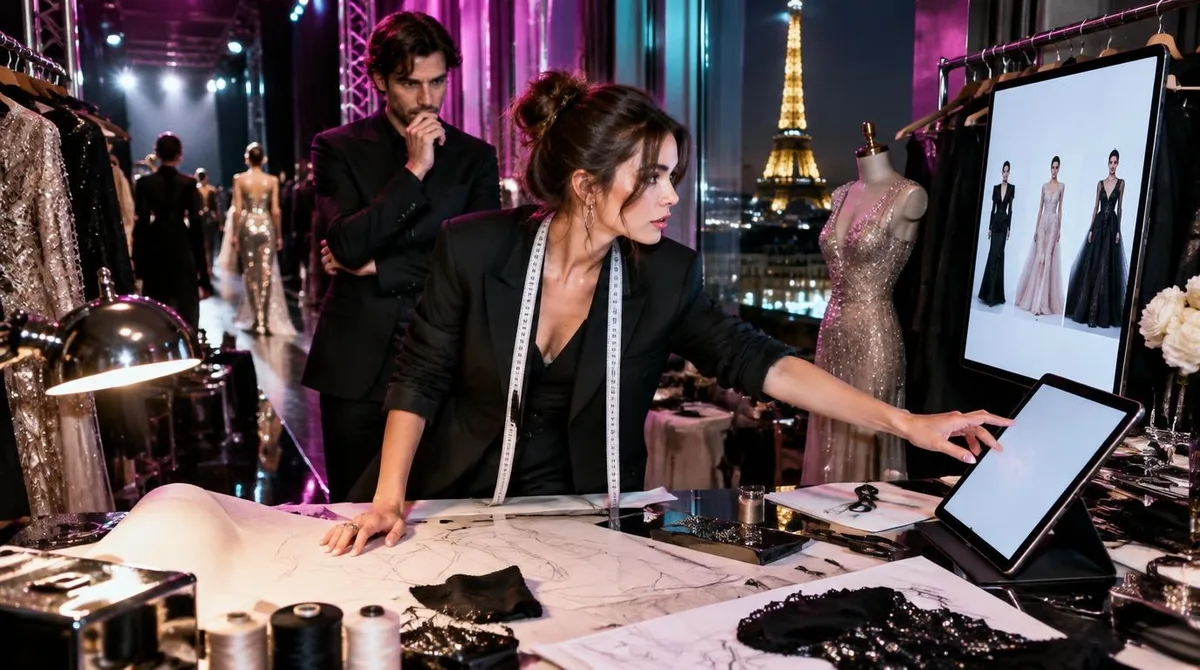
Walk into a runway venue today and the front row looks familiar. The change is behind the curtain. Fashion tech news covers the tools and platforms now shaping how clothes get designed, shown, sold, and written about, and the honest answer to which ones matter is: fewer than the headlines suggest, but the ones that do are changing the calendar itself.
As Wikipedia's overview of fashion notes, fashion has migrated online to a significant extent, and the geographic importance of the traditional fashion capitals has become less central with the arrival of artificial intelligence. That single shift explains most of the fashion tech news worth reading. When design, presentation, and retail no longer require a physical address in Paris or New York, the industry's gatekeeping changes with it.
This guide sorts the noise from the signal. We'll walk through the main categories of fashion tech news, what each one actually changes, and how to judge whether a given announcement deserves your attention or is simply a press release wearing a lab coat.
What counts as fashion tech news, and why should you care?
Fashion tech news generally falls into a handful of buckets. Design tools, meaning software that helps sketch, pattern, or prototype garments. Presentation tech, meaning virtual and hybrid runway shows, digital showrooms, and livestreamed events. Retail tech, meaning virtual fitting, digital inventory, and social commerce. And supply-chain tech, which overlaps heavily with the sustainability beat.
The reason to care is simple: technology decides what you get to see. A designer who can show a collection digitally is not bound by a fashion week slot. A brand that sells through social video is not bound by a department store's buying calendar. Follow the tech and you can often see the next season's power shifts before the reviews are written.
How are AI design tools changing the atelier?
Artificial intelligence now sits inside the design process at several stages. Generative tools can produce mood boards, colorways, and pattern variations in minutes. Software can predict which silhouettes will sell before a single sample is cut. None of this replaces a designer's eye, and the houses that lead in craft have been careful to frame AI as an assistant rather than an author.
The read: the interesting question is not whether AI can design, because on its own it cannot. The question is who controls the training data. A tool trained on a house's archive protects that house's signature. A tool trained on everyone's archive is, in effect, a trend-copying machine, and that raises the kind of legal questions we've tracked in our Fashion Law News — Fashion Law, Explained: The Headlines Behind Your Closet. Watch for lawsuits and licensing deals as the tell of where this story goes next.
Are virtual runway shows replacing the real thing?
Not replacing, but reshaping. The livestream is now standard equipment for any show that wants a global audience, and some houses have experimented with fully digital presentations, gaming platforms, and social-first formats. Our own coverage of how Louis Vuitton SS2027 Turns Paris Menswear Into a Social-Video Moment shows the direction of travel: the show is designed twice, once for the room and once for the phone. For related coverage, see Louis Vuitton SS2027 Turns Paris Menswear Into a Social-Video Moment.
Wikipedia's fashion entry makes the broader point that the rise of online presentation has loosened the grip of the four traditional capitals, New York, London, Milan, and Paris. A designer in Lagos or Seoul or Miami can now reach the same feed as a Parisian maison. That is the most consequential thing fashion tech has done in a generation, and it barely requires a gadget at all.
What this means for coverage: a virtual show is not automatically lesser, and a physical show is not automatically better. Judge the clothes. The format is just the frame.
Which retail technologies actually change how we dress?
Three are worth your attention. Virtual fitting tools, which promise to cut returns by matching garments to real body measurements, remain promising but uneven in practice. Social commerce, where a video or a livestream is the store, has already reshaped how younger shoppers discover brands. And rental and resale platforms, which run almost entirely on technology, have changed the economics of ownership itself; we've covered that shift in Luxury Resale Has Turned Every Shopper Into a Fashion Archivist. We covered a connected angle in Luxury Resale Has Turned Every Shopper Into a Fashion Archivist.
Everything else, from smart fabrics to connected jewelry, tends to generate headlines faster than wardrobes change. Treat each launch as a claim to be verified, not a trend to be declared.
How do you judge a fashion tech story like an editor?
Our analysis: apply three tests before believing any fashion tech headline.
- Who is announcing? A brand announcing its own tool is a marketing claim, not an independent finding. Company metrics come from the company, and that is exactly how they should be read.
- What number is doing the work? If a story pivots on a statistic, ask when it was measured and by whom. Fashion tech is unusually fond of projections stated as facts.
- What changes for the reader? The best tech stories end somewhere wearable, watchable, or bankable. If nothing changes for the person getting dressed, it is an industry memo, not news.
Even mainstream fashion desks have learned this filter. Hello! Fashion's rolling fashion news feed mixes designer appointments and trend round-ups with tech and lifestyle launches, and treats the launches as items to evaluate rather than events to celebrate, which is the right instinct.
Where does fashion tech go next, and what should you watch?
The near future looks less like robots and more like logistics. The technologies most likely to touch your closet are the unglamorous ones: better sizing data, faster made-to-order production, and shows that exist primarily as video. Meanwhile the creative questions, who owns a design, who gets seen, who decides what a collection is, are being renegotiated right now, and technology is the lever.
We'll be watching the next round of fashion weeks for how houses split the difference between the room and the feed, and for the first serious legal fight over AI and design authorship. Those two stories, more than any single gadget, will decide what the runway looks like by the end of the decade.