
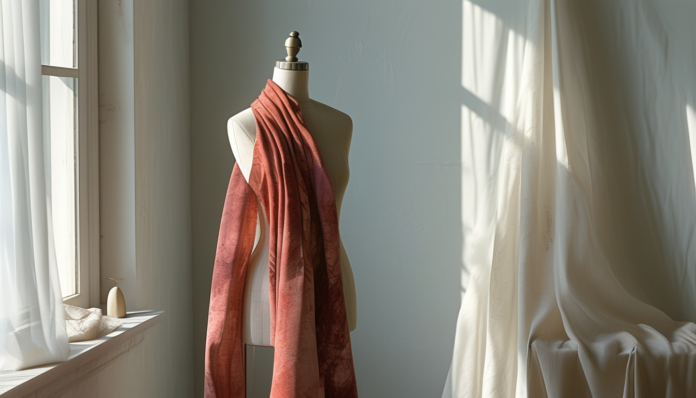

Between sketch and sample lies the unglamorous middle of fashion — toiles pinned, seams re-cut, hems argued over. With Saudi Arabia’s Fashion Commission opening The Lab in Riyadh, a facility devoted entirely to product development, the industry’s least photographed stage is finally getting a room of its own.
Every dress you have ever loved was rejected at least once before it was made. Between the sketch a designer pins to the wall and the garment that reaches a rail, there sits a long, unglamorous stretch of toiles, strike-offs, pattern revisions and fittings that the runway never shows and the lookbook never credits. The industry has started talking about this stretch more openly — Saudi Arabia’s Fashion Commission, for instance, just launched a dedicated product development studio in Riyadh called The Lab, described by the Saudi Press Agency as the kingdom’s first facility of its kind, built precisely to house this middle stage of making. That is the tell. When governments start funding the unphotogenic part of fashion, you know it is where the value lives.
So this is a guide to that middle stage: what actually happens between the sketch and the shop, and how to read the evidence of it in the clothes you already own.
What happens after the sketch is approved?
A sketch is an intention, not a garment. The first translation happens on the stand, not the page. A pattern maker — in many ateliers still called the première, a title borrowed from the tailoring workshops of the early twentieth century — takes the drawing and works out how fabric can be persuaded to do what the drawing promises. This is where the real authorship of a silhouette lives. Two pattern makers handed the same sketch will produce two different dresses, because a pattern is a set of decisions about grain, ease and seam placement that no drawing can fully specify.
The first physical version is rarely cut in the final cloth. It is cut in muslin or calico, a plain, inexpensive cotton that behaves roughly like the real fabric without costing the price of it. This provisional garment is the toile, and it exists to be wrong. It gets pinned, pencilled, sliced open and reassembled on the stand or on a fit model, and every one of those marks becomes an instruction that travels back to the pattern.
Why are fittings where the garment is actually designed?
Ask anyone who has sat through one: a fitting is a negotiation. The design that looked fluid on paper can read stiff on the body; a seam that seemed structural can turn out to interrupt the fall of the fabric at exactly the point the eye lands. Fittings are where a hem moves up two centimetres, a shoulder rotates half a degree, a pocket is moved because the hand does not travel naturally to it. None of this is trivia. Fit is the difference between a garment that is worn and a garment that is admired and returned.
The craft detail that separates a serious house from a fast one is often invisible until you look for it: interior finishing. A hand-finished lapel, where the canvas underneath the chest is shaped with stitches rather than glued, will roll and recover in a way a fused one never does. Press out the seam of a cheaply developed garment and the seam memory stays; press a properly developed one and the cloth forgets. This is not mystique. It is time, and time is what development budgets buy.
Who actually builds the sample, and why does it take so long?
Once the toile is settled, the sample comes together in stages that each carry their own failure points. Fabric is sourced and struck off, meaning a test length is dyed and approved before bulk production, because the colour on a lab dip and the colour on 200 metres of cloth are frequently not friends. Trims are sourced separately: buttons, zips, linings, interlinings, each with lead times. The sample machinist then sews the first real iteration, which goes back on the fit model, which generates more corrections, which generates a second sample. A tailored piece can easily pass through three or four. If you missed it, we covered it here: The Season Ahead: Why Fashion’s Event Calendar Has Become the Industry’s Real Runway.
The calendar quirk that outsiders always underestimate is the sequencing, not the duration. Sample rooms work across dozens of styles at once, and a single missing button shipment can hold a look out of a collection entirely. When a show is described as having a reduced look count, the honest read is often that development, not courage, made the edit.
What does a development studio change?
Here the news becomes an industry argument worth understanding. Traditionally, this work happened in-house at large houses, with ateliers down the corridor from the design studio, or was outsourced to freelance pattern rooms and small factories scattered across a region. Both models have costs: the first is expensive and slow to scale, the second scatters the knowledge. A purpose-built development studio tries to collapse the distance, putting pattern making, sampling and finishing under one roof so that a correction can be executed the same day it is decided.
The read: facilities like The Lab are an argument that product development is infrastructure, not overhead. Emerging designers without a family atelier to inherit are the obvious beneficiaries, because the barrier between them and a sellable garment has always been less about imagination than about access to the rooms where garments get fixed. Whether a state-backed studio can deliver the intangibles of a great atelier, the accumulated instincts about cloth that no equipment catalogue sells, is a fair question, and the sources so far describe the launch and its attendees rather than its results. What is established is the direction of investment: toward the making, not the marketing.
How can you tell whether the development was any good?
You can, and it is a skill worth ten minutes of anyone’s time. Turn a garment inside out. Look at three things. First, seam finishing: are the raw edges enclosed or cleanly overlocked, or left to fray into the lining? Second, pattern matching: do stripes and checks continue across a side seam, or does the pattern abruptly change its mind? Third, hang: hold the garment up from the shoulder and see whether the hemline sits level. Fabric cut off grain will twist after the first wash, and a twist tells you the pattern was laid carelessly.
Then there is the touch test for interfacing and canvas. Pinch the lapel of a jacket or the placket of a shirt between finger and thumb. If it has a crisp, layered resistance, something shaped is living inside the fabric. If it feels like two flat layers of nothing, the structure was skipped. None of this requires expertise, only attention, and it will change what you are willing to pay for.
What should you watch next?
Watch the development story become part of the story houses tell. Provenance used to mean where a fabric was woven; increasingly it will mean where a pattern was cut and by whom, and the desks that can name the hands behind the sample will be the ones readers trust. Watch, too, whether dedicated development studios multiply, because every new one redraws the map of where a young designer can realistically build a label. Related reading: Fashion Month Front Rows Are Becoming the New Talent Draft.
The next time a collection moves you, remember that the move was rehearsed in cotton first. The sketch gets the applause, the runway gets the photograph, and the toile, quietly, got you there.